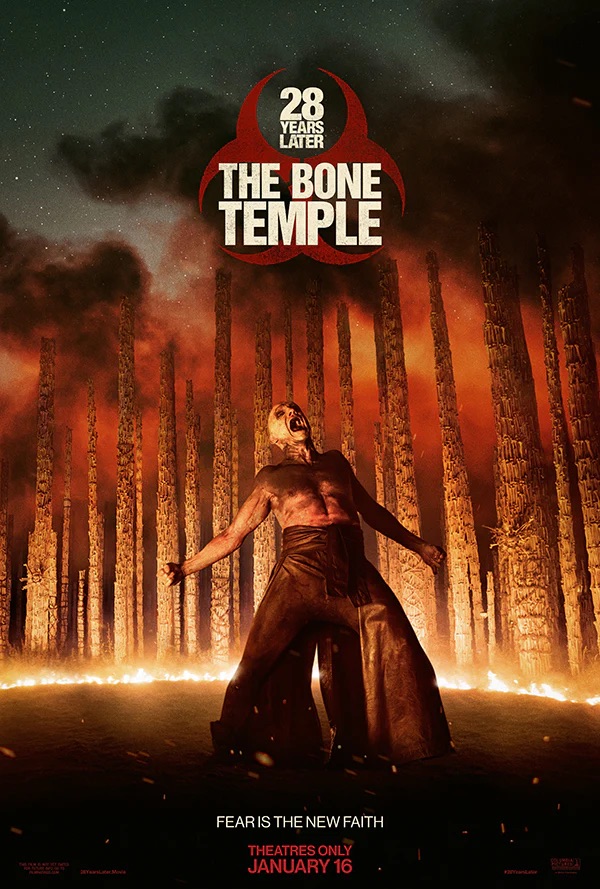
What a time to be a horror fan! ‘Sinners’ has just been honored with the most Oscar nominations in history, ‘Weapons’ is an unmitigated success, and ‘The Bone Temple’, the direct sequel to another 2025 masterpiece of the macabre, ‘28 Years Later’, wildly succeeds in taking the baton from its predecessor. ‘28YL’, itself a sequel and reunion of ‘28 Days Later’ director Danny Boyle and screenwriter Alex Garland, was a surprisingly effective coming of age tale set in the zombie overrun British Isles. It centered on young Spike (a revelatory Alfie Williams), ending with his self emancipation and encounter with a gang of violent goofs led by Jack O’Connell’s Jimmy. The new film, releasing 28 weeks later (a sly acknowledgment of the middle film in this series sans Boyle & Garland), retains many of the actors and crew, but this time it’s directed by Nia DaCosta.
‘The Bone Temple’ basically starts where the prior film left off. Spike has been taken in by O’Connell’s Jimmy and his crew of Teletubbie color-coded tracksuit brandishers. It’s immediately clear that this group, who are all referred to as “Jimmy”, are a sadistic gang completely in thrall of their leader. He seems to be the only one of the bunch born before the outbreak and he has them all believing in a “survival of the fittest”, devil-worship ethos, complete with a trial of combat initiation. In the harrowing first scene, Spike prevails against his opponent basically via dumb luck and resourcefulness to become the newest “Jimmy” against his will, bleach-blonde wig and all.
The narrative cuts back and forth between the “Jimmys” and Ralph Fiennes’ compelling returning character, Dr.Kelson. He has, for all intents and purposes, “domesticated” Samson, the raging alpha zombie that terrorized the characters in the previous film, by hooking him on morphine! This truly inspired piece of storytelling provides some incredible comedy and an uncanny zen tone in the face of truly horrific, sadistic behavior. It’s inevitable that these two stories will intersect, leaving the viewer in a constant state of dread for what’s to come.
Fiennes’ performance builds on the calm, steady, empathetic presence that both grounded and catapulted ‘28YL’ into a transcendent meditation on death and acceptance. His curiosity regarding the presence of the original individual under the layers of barbarism borne from the virus, is matched only by his profound loneliness. The relationship he forges may have come across as silly in a lesser thespian’s hands, but it also serves as the impetus of the meeting of these disparate characters otherwise linked only by their connection to Spike, which the young ward wants to avoid acknowledging at all costs.
‘28 Years Later’ had a distinct visual palette. Boyle, the consummate innovator, employed complicated camera setups using simple digital devices like iPhones. In doing so, he created sequences captured at various angles that leave an indelible mark. The score was unique in that it was electronic but fully composed by the Scottish trio Young Fathers. “The Bone Temple” by contrast evokes a more traditional horror style through DaCosta’s eye. In many ways it’s more effective as a true horror thriller, as she proves to be a deft manipulator and shock enthusiast. The score by Hildur Guonadottir is also more traditional, but it’s almost secondarily soundtracked by diegetic records by Duran Duran, Radiohead, and Iron Maiden. Since “The Bone Temple” was filmed in quick succession to ‘28YL’, it benefitted from utilization of the same outdoor sets, costumes, and basic aesthetic, lending a real cohesiveness between the films.
Nonetheless, these two movies have different agendas. Both are written by Garland, but “The Bone Temple” tells an insular tale, specifically involving a set of characters and their limited interactions. The double narrative on a collision course provides more compact storytelling than the sprawling ‘28YL’ which did the world building to set this tale of faith v science. It’s pretty obvious where the screenwriter’s loyalty lies, but in the end can anybody truly prevail in this bleak, brutal, gnarly, nihilistic long-form tale? Hopefully audiences will get to find out with a planned trilogy capper . . .
Directed By: Nia DaCosta
Written By: Alex Garland
Rated: R
Running Time: 109 min.
* * * 1/2 (out of 4 stars) – OR – A-
 liamthekid.com