
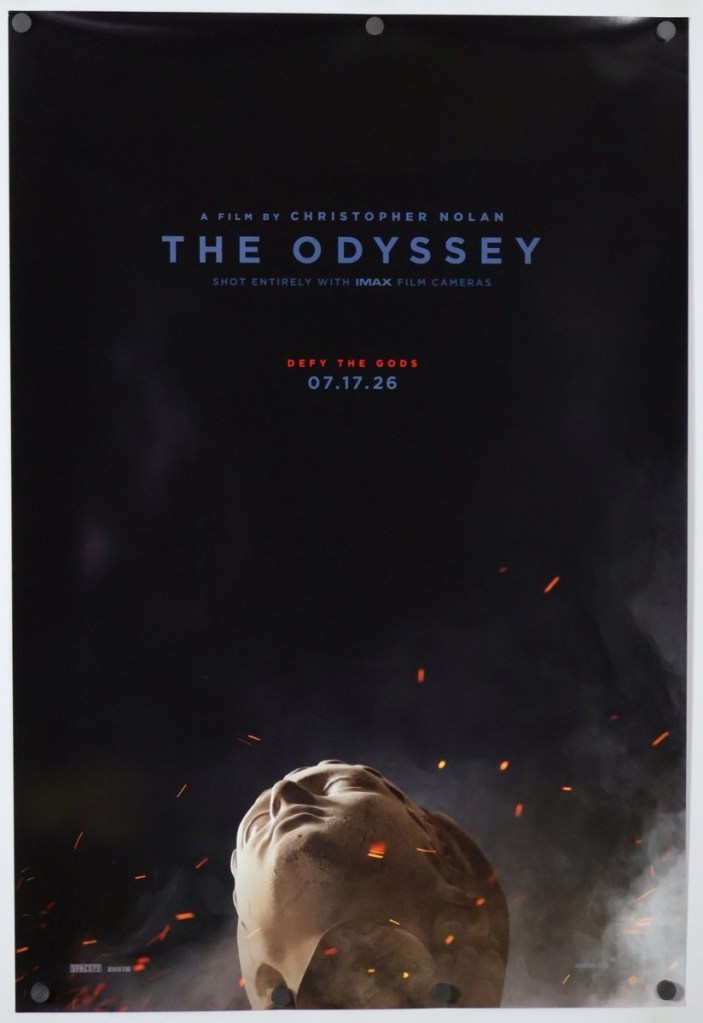
‘The Odyssey’ is here and it is a majestic, magnificent masterpiece. Writer/Director Christopher Nolan has more than earned his current status as the reigning champ of meticulously considered spectacle, an auteur at the top of his game, who lures audiences simply via his name. He’s so trusted as a filmmaker that just about every major actor has worked with him or will trip over themselves to do so. This is evidenced by ‘The Odyssey’s consistent parade of talent in an imagining of the Ancient Greek tale as blockbuster entertainment. It’s truly astounding, and kind of confounding, how successful this film ends up being, despite (or more likely due to) its bravery to just be what Nolan wants it to be, a simultaneously meditative and bombastic work of art.
He could have gone the traditional route of past sword-and-sandal epics and cast Brits espousing old school English (“art thy father” and such). He could’ve gone era authentic and cast Greeks adopting some version of their ancient language. Instead he goes the ‘Hamilton’ route and puts together a diverse cast who embody his vision for these indelible characters, as opposed to any kind of “historical accuracy”, a move that may not work for some viewers. He’s really only interested in the tone, the film’s unique thematic drive in relation to its subject matter, and its effective ability to manipulate the audience using familiar verbal cadence and situations they can imagine themselves in, as fantastical as they might be.
This is all immediately obvious from the opening of the movie. A bard is telling the tale of Odysseus, but is interrupted by a gaggle of tough guys in a dining hall. The fact that this bard is played by rapper/producer Travis Scott, and amongst the gathered are actors Tom Holland, Robert Pattinson, Corey Hawkins, and John Leguizamo, all presenting modern in their speech despite their costumes, immediately signals that Nolan is going for something more metaphorical and pop, as opposed to something striving for authenticity. It’s easy to get on board permitting one doesn’t have preconceived notions or desires about how this material should be presented. It’s even easier to fall into the film’s cadence once it bathes you in its visual splendor.
This first scene sets the stage for the narrative, but as Nolan is want, the film doesn’t waste any time quick flashing back and forth to moments past and future. The gathering in the hall is due to the vacancy of the throne of Ithaca, all suitors of the presumed (but never confirmed) widowed Queen Penelope (a steely Anne Hathaway). Chief of these assembled is Pattinson’s blatantly scheming Antinous. Wandering among them is Holland’s Telemachus, son of Penelope, an interesting character who is spiraling and powerless in the face of these rough men trying to take the place of a father he has never known. That father is the legendary Odysseus, a wonderful Matt Damon in another career-defining role, who had left his home to lead the charge against Troy for his supreme commander, Agamemnon (Benny Safdie in identity concealing, imposing black matte armor). He’s been missing for twenty years, ten of which have been since the fall of Troy, masterminded by Odysseus via that symbol of ancient warfare ingenuity, the Trojan Horse.
The story unfolds via fits and starts throughout, alternating between the present for each main character, then flashing back to Odysseus’s journey via characters’ memories of events. It all may sound jarring, but this might be Nolan’s easiest to follow time-manipulating presentation yet. In many of his films, he forces the audience to readjust their minds to tracking story beats in new and inventive ways, and ‘The Odyssey’ contains many of his signature tricks. Here they are a feature but not the point of the movie as they are in something like ‘Memento’ or ‘Tenet.’ For Odysseus himself, his present at the start of the movie is that he is seemingly blissfully content to spend all of his time with the lovely Calypso (a radiant Charlize Theron), partaking of the lotus flower which drains him of memory and ambition. He’s gradually coming out of his stupor and asking questions about how he got here and where are his men, does he have a family, etc. After setting these present states, most notably the conflict between Telemachus and his mother over whether or not his father / her husband are ever returning (Telemachus has faith, Penelope is starting to really doubt), we are thrust into the odyssey proper, post the sack of Troy.
Odysseus and his men decide to take a different route home, which sets them on their fraught journey. The familiar story beats of the ancient poem are all represented here, but in anything but familiar ways. Each sequence has its own horrific flavor, from the claustrophobia of the Cyclops segment, to the body transfiguration at the sculpting hands of Circe (Samantha Morton, appropriately guarded). It’s only when the film cuts back to Telemachus on his own mini trek (albeit supervised by soldier Mentor) to Sparta do we get the Troy sequence shown in the previews. The tale is delivered by Jon Bernthal as Menelaus, in the gruff and tough manner as only he can provide, painting a picture of the account from only his own perspective, with grave sacrifice and heroic military planning. Odysseus’s crew becomes increasingly hopeless as it dwindles, their captain’s actions many times defying logic. A lot of this doubt is well personified by Himesh Patel as Odysseus’s right hand man, Eurylochus, a character that almost serves as the audience surrogate.
Everything about ‘The Odyssey’ is extremely well considered and executed. Nolan stretches the limits in his embrace of IMAX cameras and as many practical effects as he can muster, creating an immersive theatrical experience that lives up to the hype and then some. Composer Ludwig Goransson is back as Nolan’s preferred collaborator and he seems poised for another Oscar for this unique score, employing ancient instrumentation to create a singular soundtrack to the magical story. Everything here is in service to this melancholic presentation that ultimately explores the human condition. It’s a lofty ambition that Nolan, his cast, and most importantly, his crew, fully appreciate. They all help bring this ancient tale to life for a modern audience, as hungry for artistry as they are for big budget entertainment . . .
Written & Directed By: Christopher Nolan
Running Time: 173 min.
Rated: R
* * * * (out of 4 stars)

